
Today
January 2025
“Hinsch Zoo” on Permanent Loan to Plassenburg Museum
Our “Hinsch Zoo – Series 54” is now on permanent loan to the Plassenburg Museum. Watch the video.
February 2025
TV Feature “Starker Osten”
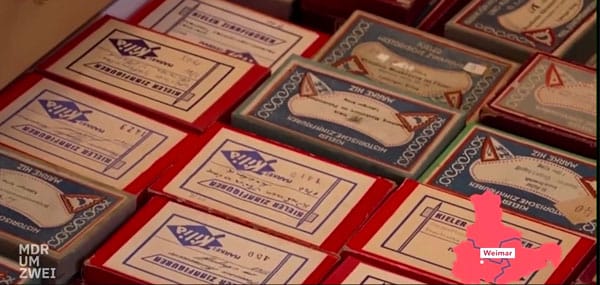
Kieler Zinnfiguren and Marbod Gerstenhauer on MDR Television Watch the video.
November 2024
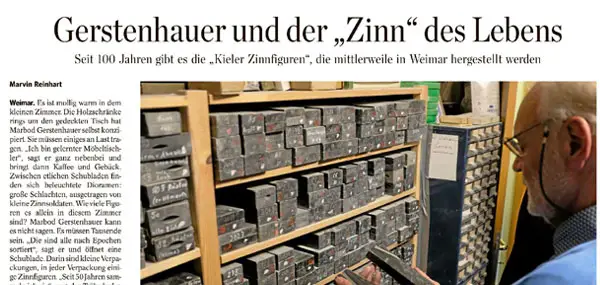
Autumn 2024
Handover of Website Management
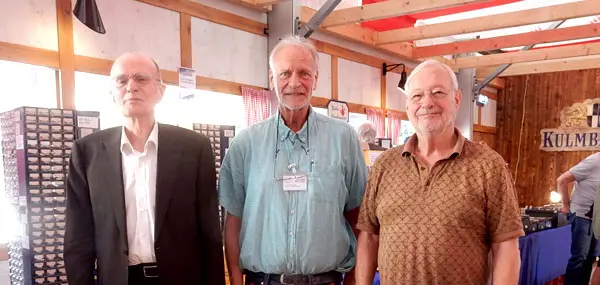
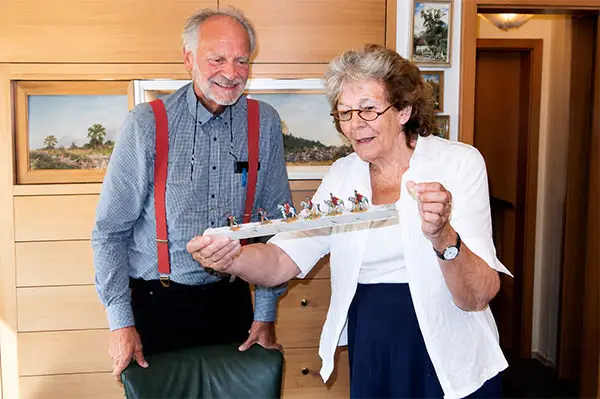
After 15 years, Dr Werner Lehnberg hands over the design and maintenance of the website to Marbod Gerstenhauer.
Dr Werner Lehnberg of Wolfenbüttel worked as a marine biologist in Kiel and was a close friend of Erika Ochel. He developed the Kieler Zinnfiguren website for her, making an important contribution to the company's continued existence. He managed the website for Erika Ochel for more than ten years and continued in this role for another five years after the company was acquired in 2019.
At the 2024 International Pewter Figure Fair in Kulmbach, he asked to hand over responsibility for the website due to his age.
We would like to express our heartfelt thanks to Dr Werner Lehnberg for his exceptional work, many years of dedication and tremendous effort since the website's beginnings. His commitment has played a major part in preserving and sharing the history and tradition of Kieler Zinnfiguren in the digital age.
(Photo, right to left: Dr Werner Lehnberg, Marbod Gerstenhauer, Dr Ochel)
Summer 2024
Reunification of All Mould Collections
Marbod Gerstenhauer succeeded in reuniting all the moulds that had become separated from the Kieler Zinnfiguren workshop. The collection is now complete!
2024
100 Years of Kieler Zinnfiguren – Anniversary Exhibition
From 8 February to 30 December 2024, the German Pewter Figure Museum presented a unique anniversary exhibition. For the first time, exhibits representing 100 years of the Kieler Zinnfiguren (Kilia) workshop were brought together on such a broad scale.
Watch this excellent television report.
The exhibition traced the development of Kiel pewter figures from their beginnings to elaborate dioramas, showcasing achievements from Germany and abroad. More than 40 lenders contributed exhibits, including scenes from Karl May's adventures, musketeers and heroes of bygone eras, fairy tales and the legendary Hinsch Zoo, never before exhibited in this form.
The exhibition was open during regular museum hours. AMuseum guideand a special commemorative figure were also released. Both can be ordered from the Kieler Zinnfiguren workshop.
Here are some impressions of the exhibition:
Exhibition tour > 7 minutes
Exhibition tour 2
Exhibition tour 3
Exhibition tour 4
Exhibition tour 5
August 2023

2023
Special Exhibition in Kulmbach
Since the beginning of the year, preparations have been in full swing. Painters, lenders, collectors and especially Mr Gerstenhauer are focusing on the upcoming anniversary and planning a special exhibition in Kulmbach. Watch the video: https://www.kieler-zinnfiguren.de/100%20Jahre%20Kilia.mov
2022
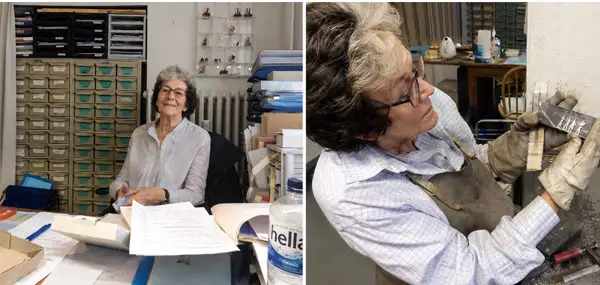
Erika Ochel verstirbt am 3. November ✝
2020
Kieler Zinnfiguren and Marbod Gerstenhauer on MDR Television
Kieler Zinnfiguren and Marbod Gerstenhauer on MDR Television https://www.kieler-zinnfiguren.de/video2025_2.mov
2019
Acquisition by Marbod Gerstenhauer and Continuation in Weimar
In November, Marbod Gerstenhauer acquired Kieler Zinnfiguren. More than 4,000 moulds were carefully packed and transported to Weimar, where production would continue.
2009
Online Relaunch and Return to Kulmbach
In spring 2009, a website was launched and Erika Ochel resumed production on a small, private scale. She also returned to the Kulmbach Pewter Figure Fair.
1997
Farewell to Kieler Zinnfiguren and Closure of the Company
In 1997, Kieler Zinnfiguren attended the International Pewter Figure Fair in Kulmbach for the last time. During the fair, Erika Ochel informed collectors that the company would cease operations at the end of the year. Sadly for collectors worldwide, the closure went ahead. From December 1997, the company ceased to operate after more than six decades.
1993/94
Restoration of the Mould Collection and First Comprehensive Catalogue
In 1993–94, Erika Ochel commissioned the Schmittdiel workshop to restore a large proportion of the casting moulds. This work provided the basis for the first comprehensive catalogue of Kieler Zinnfiguren. During the project, Fritz Hüther discovered a number of previously undocumented figures, which were presented to collectors for the first time. The work was completed in October 1994, when the company held 4,217 moulds.
1991
Relocation
In 1991, the company moved to Schülper Baum 23 in Kiel.
1979
Aloys Ochel Dies in Kiel ✝
1972
Erika Kroschewski Takes Over Management of the Company
After having helped run the business for some time, Aloys Ochel's daughter Erika, married name Kroschewski, formally took over its management, as recorded in the Kiel commercial register. For almost two decades she worked in the spirit of Aloys Ochel, safeguarding the extensive mould collection despite numerous difficulties, expanding it particularly with arts-and-crafts subjects, and ensuring that collectors in Germany and abroad could continue to obtain Kieler Zinnfiguren.
1957
A New Generation of Engravers
In 1957, Ludwig Frank died in Nuremberg. His death was a great loss to collectors and publishers: one of the most prolific master engravers in the history of pewter figures, he had created thousands of new figure designs. Kieler Zinnfiguren was especially affected, as Frank had worked for the company since its founding in 1924. However, Aloys Ochel had already begun commissioning promising young artists and engravers. Over the years, around 60 designers and engravers contributed to the development of Kieler Zinnfiguren.
1953
Co-founder of the Kulmbach Pewter Figure Fair
In 1953, Aloys Ochel was among the initiators and founders of the Kulmbach Pewter Figure Fair. Held annually, it quickly grew from a regional gathering into the most important event for the international collecting community. Its success owed much to the outstanding reputation of Kieler Zinnfiguren and Aloys Ochel among collectors worldwide, both before and especially after the war.
From 1950
Expansion into Germany’s Leading Pewter Figure Manufacturer
From 1950 onwards, the Kiel company's range expanded considerably through new subjects, numerous new engravings and the acquisition of mould collections from other publishers, including Bruno Hinsch of Hamburg. By the time Aloys Ochel retired in the early 1970s, the company supplied collectors worldwide with around 10,000 different figures cast from approximately 4,200 moulds and sold in more than 1,500 sets. Since Heinrichsen in Nuremberg had not resumed production after the war, while other workshops such as Rieche in Hanover and Zeumer in Dresden had been destroyed in air raids, Kieler Zinnfiguren remained Germany's most important pewter figure manufacturer until its closure.
1946
Resumption of Production
After the Second World War, production resumed relatively quickly despite continuing shortages of raw materials and temporary reservations about pewter figures because of their military associations. The company was renamed “Kieler Zinnfiguren A. Ochel”, and its range increasingly focused on civilian subjects. After the war, Aloys Ochel occupied premises at Brunswicker Straße 7 in Kiel, later moving to Feldstraße 24.
1944
Destruction of the Company Building
In 1944, a major air raid on Kiel struck the company's building, which burned down completely. The portion of the company archives that had not been moved to safety, including original drawings covering almost every historical period, was also destroyed.
1943
Relocation of the Mould Collection and Archives to Preetz
In 1943, following the first British and American air raids on Kiel, the mould collection and part of the company archives were moved to a former slaughterhouse in Preetz, in the Plön district.
After 1940
Wartime Suspension of Deliveries to Private Customers
After 1940, deliveries to private customers were officially discontinued, primarily because wartime arms production caused shortages of materials. Larger orders for the Wehrmacht, involving so-called sand-table figures, are mentioned repeatedly in the literature but have not been substantiated, at least not on the scale sometimes claimed.
1936
Ochel Acquires the Moulds of the Original Kiel Company
In 1936, Ochel announced in specialist magazines that he had taken over the moulds of the original Kiel company and that its figures could now be ordered from him.
1935
Final New Releases and End of Production
New releases from the “Kieler Zinnfigurenfabrik” continued to be offered in 1935. During the first year in which the two companies operated side by side, the original firm actually released considerably more new figures than A. Ochel's newly founded company. However, production officially ceased towards the end of 1935.
1933
Departure of Max Hahnemann
In the autumn, Max Hahnemann announced in the Klio journal “Die Zinnfigur” that he was leaving the company he had previously managed to join Aloys Ochel's new business.
1933
Founding of “Kieler Zinnsoldaten A. Ochel”
In 1933, the new Kiel pewter figure factory was founded under the name “Kieler Zinnsoldaten A. Ochel”. Aloys Ochel continued the fine traditions of the original Kiel company. His factory-painted figures were offered in two quality categories:
> KILIA – high-quality figures with carefully applied paintwork
> OKI – simple paintwork
At the same time, he announced that unpainted figures would also be available.
1932/33
Economic Crisis and Departure of Aloys Ochel
Like most businesses during the Great Depression, the Kiel pewter figure factory faced serious financial difficulties. In order to preserve the mould collection for the future and secure his own livelihood, Aloys Ochel left the company and set out to establish a business of his own.
1931
Move to Fleethörn
The company moved to Fleethörn 29 in Kiel. It subsequently operated under the name “Kieler Zinnfigurenfabrik GmbH”.
1929
Pewter Figure Exhibition in Berlin
In 1929, a major exhibition of Kiel pewter figures opened at the Europa-Haus on Königgrätzer Straße in Berlin. Twenty-two large dioramas, made entirely with Kieler Zinnfiguren, depicted periods of world history from ancient times to the present day.
1928
Move to Kiel
The company moved to the Eichhof industrial complex in Kiel. Under Hahnemann and Ochel, the factory continually expanded and updated its range by exploring new subjects. Production of the model ship series began that year.
1927
Aloys Ochel
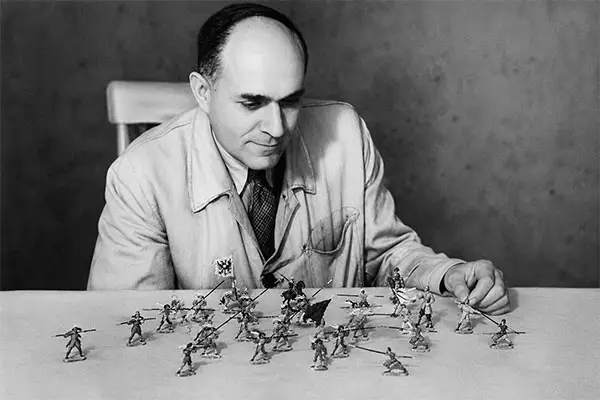
In 1927, Aloys Ochel, a businessman born in Kiel in 1906, joined the rapidly growing company as managing director after its original shareholders had withdrawn.
1926/27
The First Main Catalogue
In 1926, the first main catalogue was published, listing all figures released up to that point.
1924
The Beginning
A group of pewter figure collectors, whose names are no longer known, founded the “Fabrik für historische Zinnfiguren und Kulturbilder G.m.b.H.” (Factory for Historical Pewter Figures and Cultural Scenes). They appointed Max Hahnemann, a collector and reserve officer already well known before the First World War, as managing director. The new company was based at Jungmannstraße 24 in Kiel. From then on, the workshop produced pewter figures to high historical and artistic standards in two quality grades:
> HIZ brand – fine metal and historically accurate painting
> BIZ brand – simple alloy and paintwork
Almost all figures were sold painted, in themed sets and battle sets, to customers and enthusiasts who were beginning to form organised collecting communities in Germany and other European countries.